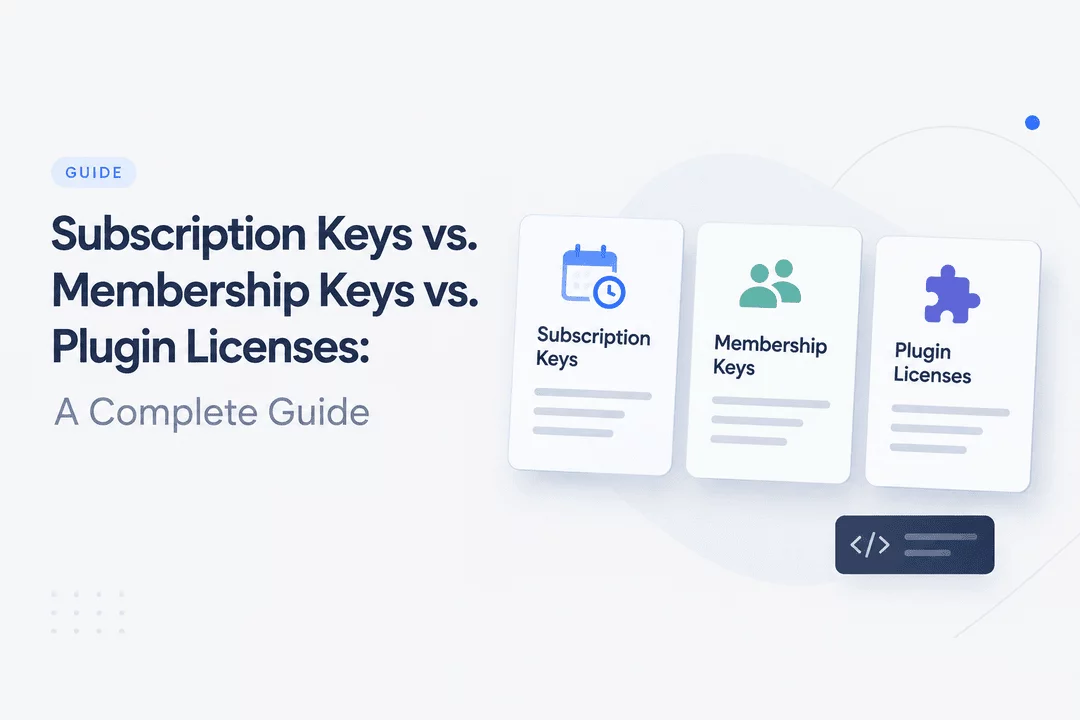
Subscription Keys vs. Membership Keys vs. Plugin Licenses: A Complete Guide
Selling digital products online often involves more than simply delivering a downloadable file. Many businesses sell products that require a subscription key, membership key, or plugin license to give customers access to software, services, content, or premium features.
Although these terms are sometimes used interchangeably, they serve different purposes. Understanding the differences can help Shopify merchants choose the right delivery and licensing workflow for their digital products.
In this guide, we’ll explain what subscription keys, membership keys, and plugin licenses are, how they work, and how Shopify merchants can deliver them automatically after purchase.
What Are Subscription Keys?
A subscription key is a code that gives a customer access to a product or service for a specific period of time.
For example, a software company might sell:
- 1-month subscription keys
- 6-month subscription keys
- 12-month subscription keys
- Annual software licenses
- Premium service access
- API subscription keys
- Streaming or online-service access
A subscription key may be connected to an expiration date. Once the subscription period ends, the customer may need to renew their purchase and receive another key.
Example
Imagine a Shopify store selling access to a design software service.
A customer purchases a 12-month plan and receives:
Subscription Key: ABCD-1234-EFGH-5678
The customer enters the key into the software or account dashboard to activate their subscription.
This allows the merchant to sell subscription-based digital products without manually sending activation codes to every customer.
What Are Membership Keys?
A membership key is generally used to provide access to a membership, community, content library, or restricted area.
Unlike a traditional software license, a membership key is often associated with access privileges rather than software activation.
Membership keys can be used for:
- Online communities
- Premium content
- Educational platforms
- Private websites
- Digital libraries
- Online courses
- Customer portals
- Premium newsletters
- Coaching programs
- Exclusive resources
Example
A Shopify merchant sells a one-year membership to a private educational platform.
After purchasing the membership, the customer receives a membership key that can be used to activate or claim their access.
The merchant can then manage different membership products, durations, and access levels.
What Are Plugin Licenses?
A plugin license is a license key that allows a customer to activate and use a software plugin.
Plugin licenses are especially common among:
- WordPress plugin developers
- Shopify app developers
- WooCommerce developers
- Desktop software developers
- Design software companies
- Audio plugin developers
- Developer tools
- Productivity software companies
A plugin license might determine:
- Whether the software is activated
- How many websites can use it
- How long updates are available
- Whether premium features are enabled
- Whether customer support is included
Example
A developer sells a premium WordPress plugin through Shopify.
After checkout, the customer receives:
License Key: PLUGIN-2026-ABCD-7890
The customer enters the license into the plugin's settings to activate premium functionality.
Subscription Keys vs. Membership Keys vs. Plugin Licenses
While these products have similarities, their primary purposes are different.
Feature | Subscription Keys | Membership Keys | Plugin Licenses |
Main purpose | Service or software access | Membership access | Software activation |
Usually time-limited | Yes | Often | Often |
Used with software | Often | Sometimes | Yes |
Used with communities | Sometimes | Yes | No |
Activation required | Usually | Sometimes | Usually |
Renewal possible | Yes | Yes | Yes |
Common use cases | SaaS, APIs, services | Courses, communities, premium content | Plugins and software |
The exact implementation depends on how the product or service provider has designed its licensing system.
How Digital Key Delivery Works
For an online store, the basic workflow is straightforward:
Customer purchases → Shopify confirms order → Key is assigned → Customer receives key → Customer activates product
Without automation, a merchant may need to manually find an available key and email it to the customer.
This can become difficult when orders increase.
For example, if a store receives 100 digital-key orders per day, manually processing each order can consume significant time and introduce errors.
An automated digital delivery system can handle the process instead.
Why Automated Key Delivery Matters
Automation can make digital product fulfillment faster and more consistent.
1. Instant delivery
Customers don't necessarily need to wait for a merchant to manually send their key.
The key can be delivered automatically after a successful purchase.
2. Fewer manual tasks
Instead of copying and pasting keys into individual emails, merchants can automate fulfillment.
3. Better customer experience
Customers can receive their activation information shortly after completing checkout.
4. Easier inventory management
Merchants selling large numbers of unique keys can maintain a pool of unused license codes and assign them as orders arrive.
5. Reduced human error
Automated workflows can reduce problems such as:
- Sending the wrong key
- Sending the same key twice
- Forgetting to send a key
- Copying an activation code incorrectly
How to Sell Subscription Keys on Shopify
Shopify can be used as the storefront for selling digital subscription keys.
A typical workflow looks like this:
Step 1: Create your product
Create a Shopify product for your subscription plan.
For example:
- Monthly Subscription
- 6-Month Subscription
- Annual Subscription
Step 2: Prepare your keys
Create or obtain the unique subscription keys that customers will receive.
Step 3: Connect your digital delivery system
Use a digital product delivery solution to associate your keys with the corresponding Shopify product.
Step 4: Customer places an order
The customer completes the Shopify checkout process.
Step 5: Deliver the key
After the order is processed, the customer's unique subscription key can be delivered through the configured digital delivery workflow.
How to Sell Membership Keys on Shopify
Membership products can follow a similar process.
For example, you could create products such as:
Basic Membership
Premium Membership
Annual Membership
Each product can have its own set of access keys.
When a customer purchases a membership, the appropriate key can be delivered automatically.
You can also create different key pools for different membership levels.
For example:
Product | Key Type |
Basic Membership | Basic access key |
Premium Membership | Premium access key |
VIP Membership | VIP access key |
This makes it easier to manage different levels of digital access.
How to Sell Plugin Licenses on Shopify
Plugin developers can also use Shopify as a storefront for license-based products.
A typical workflow might look like:
Plugin purchase → License assigned → License delivered → Customer activates plugin
You could sell different license types, such as:
- Single-site license
- 5-site license
- Unlimited license
- Personal license
- Business license
- Annual license
Each product can be connected to its corresponding license-key inventory.
Using Digitally for Key and License Delivery
Digitally – Digital Products helps Shopify merchants deliver digital products, files, links, license keys, and activation codes after purchase.
Instead of manually sending every code, merchants can create automated delivery workflows directly around their Shopify products.
With Digitally, merchants can work with license keys, activation codes, subscription keys, and other unique codes.
You can also import license keys in bulk using CSV, making it easier to manage large inventories.
For merchants selling digital products at scale, this can simplify the process from purchase to delivery.
Bulk License Key Management
If you sell hundreds or thousands of license keys, adding codes individually can become inefficient.
Bulk importing can make the process much easier.
For example, you might have a CSV containing:
KEY-001-ABCD
KEY-002-EFGH
KEY-003-IJKL
KEY-004-MNOP
These keys can be imported into your digital delivery workflow and assigned to customers as orders are fulfilled.
This is particularly useful for businesses selling:
- Software licenses
- Game keys
- Subscription codes
- Membership access
- API keys
- Plugin licenses
- Activation codes
Can One Order Receive Multiple Keys?
Yes, some digital products require multiple keys per purchase.
For example, suppose a customer purchases 2 units of a product and each unit requires 3 activation keys.
The merchant may need to deliver:
2 × 3 = 6 keys
A digital delivery system that supports configurable key quantities can help automate this type of workflow.
This is useful when the number of keys depends on the quantity purchased.
Subscription Keys, Membership Keys, and Plugin Licenses: Which Should You Use?
The answer depends on what you're selling.
Use subscription keys when access is tied primarily to a recurring or time-limited service.
Use membership keys when the code provides access to a membership, community, content library, or restricted platform.
Use plugin licenses when customers need to activate software or a plugin.
In some businesses, these models can overlap. For example, a software company might sell a plugin license that expires after one year and requires annual renewal.
The important thing is to define what the key grants access to, how long that access lasts, and how customers activate it.
Best Practices for Selling Digital Keys
Keep every key unique
Avoid accidentally assigning the same activation code to multiple customers unless the code is intentionally reusable.
Track key availability
Knowing how many unused keys remain can help prevent fulfillment problems.
Automate delivery
Automatic delivery reduces manual work and helps customers receive their keys faster.
Use clear customer instructions
Tell customers exactly where to find their key and how to activate it.
Protect sensitive codes
License keys and activation codes can have monetary value. Avoid exposing them unnecessarily.
Plan for renewals
If keys expire, clearly explain the renewal process and expiration terms.
Maintain organized key inventories
Separate keys by product, plan, duration, or license type when necessary.
Final Thoughts
Subscription keys, membership keys, and plugin licenses all provide a way to deliver digital access, but they are designed for different use cases.
Subscription keys are commonly associated with time-based services or software access. Membership keys can provide access to communities, content, or restricted platforms. Plugin licenses are primarily used to activate and manage software products.
For Shopify merchants selling these types of digital products, automated delivery can simplify fulfillment and reduce repetitive manual work.
With Digitally – Digital Products, Shopify merchants can deliver files, custom links, license keys, activation codes, and other digital products as part of an automated fulfillment workflow.
Whether you're selling software subscriptions, premium memberships, plugin licenses, or other digital products, having a reliable delivery process can make managing digital orders much easier.
Frequently Asked Questions
A subscription key typically provides access to a software product or service for a specific period, while a membership key usually provides access to a membership, community, course, content library, or restricted platform.
A plugin license is a unique code that allows a customer to activate and use a software plugin. Depending on the licensing model, it may also define the number of websites, duration of access, updates, or support included.
Yes. Shopify merchants can sell subscription keys as digital products and use a digital delivery system to automatically provide customers with their unique keys after purchase.
Yes. Digitally – Digital Products can help Shopify merchants deliver license keys, subscription keys, membership codes, and activation codes automatically after a customer completes a purchase.
Yes. Merchants selling large quantities of unique codes can use bulk key management to import license keys, making it easier to maintain and distribute a large key inventory.
Digitally allows Shopify merchants to connect digital products with license keys or activation codes and automate their delivery, reducing the need to manually send codes to customers after every order.
Subscription Keys
Membership Keys
Plugin Licenses
Activation Codes
digitally
Digital Downloads

Digitally ‑ Digital Products
Sell files, e-books, license keys, promo codes & digital links
 Install Now