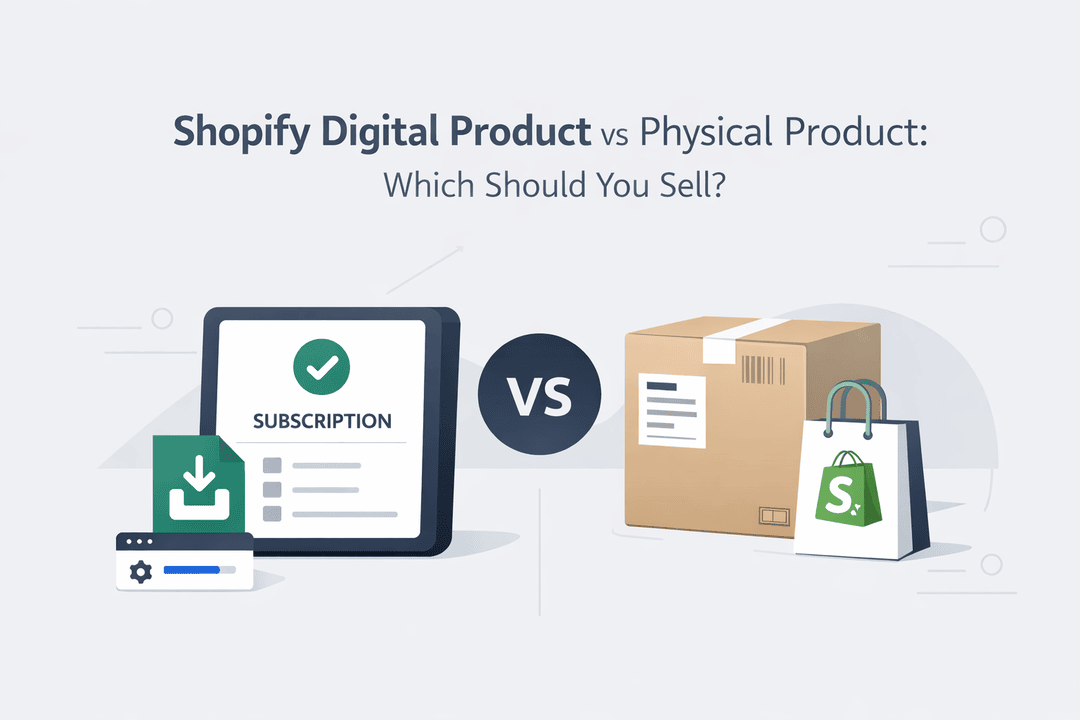
Shopify Digital Product vs Physical Product: Which Should You Sell?
If you’re starting—or scaling—a Shopify store, one of the first big decisions you’ll face is what type of products to sell: digital or physical.
Both models can be profitable. But they operate very differently when it comes to costs, fulfillment, scalability, and long-term growth.
In this guide, we’ll break down digital vs physical products on Shopify, compare their pros and cons, explore profit margins and scalability, and help you decide which model fits your goals best.
What Is a Digital Product on Shopify?
A digital product is something customers can download or access instantly after purchase. There’s no shipping, no inventory, and no physical handling involved.
Common digital product examples on Shopify:
- Software license keys
- Ebooks & PDFs
- Online courses
- Templates (designs, resumes, Notion, Excel)
- Music, photos, videos
- Memberships & subscriptions
Delivery is usually handled through a digital delivery app like Digitally, which automates fulfillment and sends files or license keys instantly—24/7, hands-free.
What Is a Physical Product on Shopify?
A physical product is a tangible item that must be manufactured, stored, packed, and shipped to customers.
Common physical product examples:
- Clothing & accessories
- Electronics
- Home décor
- Beauty products
- Printed books
- Dropshipping items
This model involves logistics such as inventory management, shipping carriers, returns, tracking, and sometimes fulfillment centers.
Pros & Cons of Selling Digital Products on Shopify
✅ Pros
- Instant delivery (24/7)
- No inventory or storage
- Near-zero fulfillment costs
- Very high profit margins
- Easy to sell globally
- Perfect for automation and passive income
❌ Cons
- Easier for competitors to copy
- Requires trust-building (branding, previews, demos)
- File protection and license control matter
Pros & Cons of Selling Physical Products on Shopify
✅ Pros
- Customers instantly understand physical products
- Harder to copy than digital goods
- Strong branding and lifestyle potential
- Lower piracy risk
❌ Cons
- Inventory and storage costs
- Shipping delays cause abandoned carts
- Returns and damaged goods
- Lower profit margins
- Harder to scale internationally
Cost Breakdown: Which Is Cheaper to Start?
Digital Products
Typical costs:
- Shopify plan
- Digital delivery app
- Time or tools to create content
💰 Startup cost: Very low
Once created, digital products cost almost nothing to sell again.
Physical Products
Typical costs:
- Manufacturing or supplier fees
- Storage and inventory
- Packaging
- Shipping
- Returns and replacements
💰 Startup cost: Medium to high
Every sale adds ongoing expenses.
Profit Margins: Digital Wins by a Mile
Digital Products
Digital products have exceptionally high margins because there are no per-unit costs after creation.
Margin reality:
➡️ 80–95% profit margins are common
You can sell the same file, license key, or course unlimited times with zero extra cost.
Physical Products
Physical products incur costs on every sale.
Margin reality:
➡️ 20–50% margins, often lower after refunds and shipping
Even successful stores see margins shrink due to logistics
Scalability: Automation vs Operations
Digital Products
Digital products scale effortlessly.
- Sell 10 or 10,000 units with the same setup
- Instant global delivery
- No warehouses
- No extra staff
- No shipping delays
Once automated, digital products run 24/7.
Physical Products
Scaling physical products adds complexity.
- More inventory
- More suppliers
- More customer service
- More shipping issues
- Higher risk of errors
Growth often means higher overhead and stress.
Refunds & Chargebacks: Fewer Headaches with Digital
Digital Products
Refunds depend on setup—but done right, they’re usually lower.
Why refunds are reduced:
- No damaged items
- No shipping delays
- Clear product descriptions
- Instant delivery
Best practices:
- Offer previews or demos
- Set clear refund policies
- Use secure, automated delivery
Physical Products
Refunds are more common and costly.
Common reasons:
- Late deliveries
- Wrong size or color
- Damaged items
- Buyer’s remorse
Each return costs money in shipping, handling, and restocking.
Customer Support: Low-Touch vs High-Touch
Digital Products
Support volume stays low, even at scale.
Common questions:
- “Where’s my download?”
- “How do I access my file?”
- “My license key isn’t working”
Automation solves most of these instantly.
Physical Products
Support grows with sales.
Common issues:
- Order tracking problems
- Shipping delays
- Damaged items
- Returns and exchanges
Support scales linearly with order volume.
At a Glance Comparison
Factor | Digital Products | Physical Products |
Profit margins | Very high (80–95%) | Moderate (20–50%) |
Scalability | Instant & global | Operationally heavy |
Refunds | Low (with clear policies) | High & costly |
Support load | Low | High |
Fulfillment | Fully automated | Manual or 3PL |
Stress level | Low | Higher |
Which Should You Sell on Shopify?
Choose digital products if you:
- Want passive or semi-passive income
- Prefer automation
- Sell knowledge, software, or files
- Have a global audience
- Want higher margins
Choose physical products if you:
- Want to build a lifestyle or brand business
- Sell unique tangible goods
- Enjoy sourcing and logistics
- Need a more defensible product
Can You Sell Both on Shopify?
Absolutely—and many successful stores do.
Popular hybrid examples:
- Software + paid upgrades
- Physical product + digital guide
- Online course + merchandise
- Ebook + coaching package
Hybrid models increase average order value and customer lifetime value.
Frequently Asked Questions
The main difference is delivery and fulfillment. Digital products are delivered instantly after purchase with no shipping or inventory, while physical products require manufacturing, storage, shipping, and returns management.
Yes, in most cases. Digital products often have profit margins between 80–95% because there are no per-unit costs after creation. Physical products usually have margins between 20–50% due to manufacturing, shipping, and returns.
Absolutely. Digital products are beginner-friendly because they require low startup costs, no inventory, and can be fully automated using a digital delivery app like digitally.
Physical products can be better for lifestyle and brand-focused businesses since customers can touch, wear, or use them. However, strong branding is still possible with digital products like courses, software, and memberships.
Yes. Many successful Shopify stores use a hybrid model, such as selling a physical product with a digital guide, or a software product with paid upgrades and subscriptions.
Digital products are significantly easier to scale. You can sell unlimited copies without increasing costs, staff, or logistics. Physical products scale more slowly due to inventory, shipping, and operational complexity.
Usually, yes. Digital products avoid issues like shipping delays and damaged goods. With clear product descriptions, previews, and secure delivery like Digitally refund rates are often lower than physical products.
Digitally
Digital vs Physical Products
Shopify Digital Products
Digital Products on Shopify
Physical Products on Shopify
Sell Digital Products Online
Ecommerce Profit Margins
Digital Product Fulfillment

Digitally ‑ Digital Products
Sell files, e-books, license keys, promo codes & digital links
 Install Now