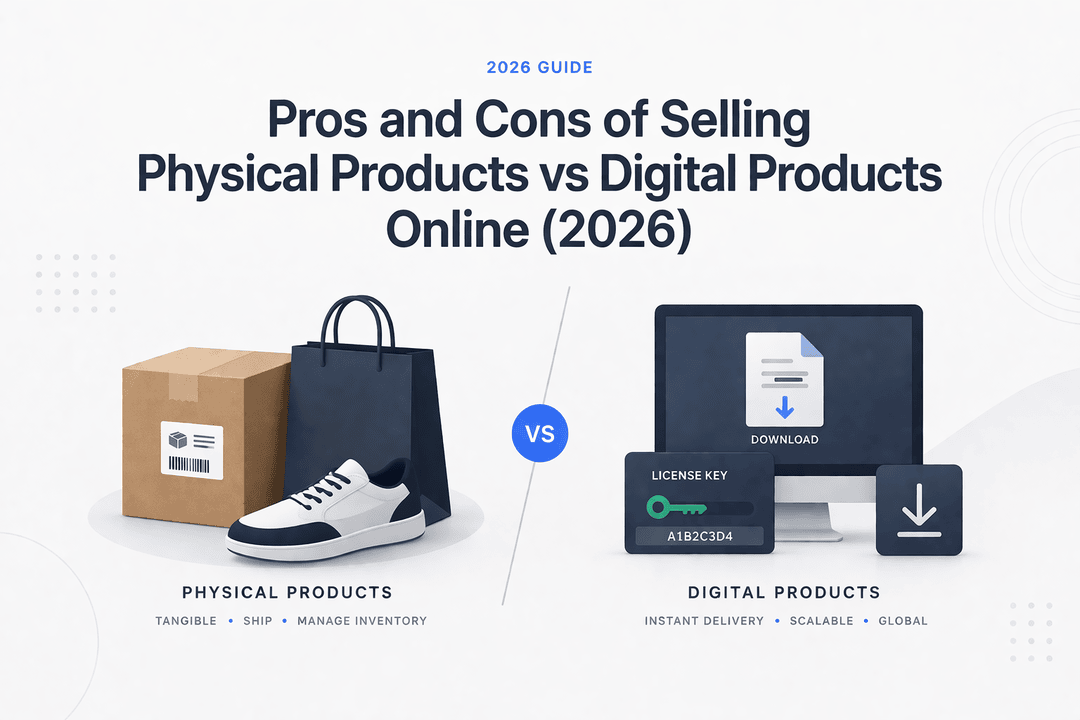
Pros and Cons of Selling Physical Products vs Digital Products Online (2026)
If you're starting (or scaling) an online business in 2026, one question comes up almost immediately:
Should you sell physical products or digital products?
It’s not just a technical decision—it affects your costs, your time, your risk level, and how fast you can grow.
Some entrepreneurs build massive brands selling physical goods. Others quietly generate high-profit income streams selling digital products with almost no overhead.
So which one is better?
Let’s break it down in a real-world, no-fluff way.
The Core Difference (In Simple Terms)
At the most basic level:
- Physical products = things you can touch (clothes, gadgets, accessories)
- Digital products = things you download or access online (software, PDFs, courses, license keys)
Sounds simple—but the business impact is huge.
Selling Physical Products: The Reality
Selling physical products is what most people think of when they hear “ecommerce.” It’s familiar, proven, and powerful—but it comes with baggage.
What Makes Physical Products Attractive?
There’s a reason brands still build billion-dollar businesses around physical goods.
First, people trust them more. Customers can see, feel, and use what they buy. That alone increases conversion rates.
Second, physical products are easier to brand and differentiate. Packaging, design, and even the unboxing experience can turn a simple product into something memorable.
And let’s not forget—the market is massive. Everyone buys physical items online.
Where Things Get Complicated
Here’s where reality kicks in.
You don’t just “sell” physical products—you manage them.
You need:
- Inventory
- Storage
- Shipping
- Returns handling
That means upfront investment and ongoing stress.
Margins can also get tight. Once you factor in manufacturing, shipping, and platform fees, profits shrink faster than expected.
And scaling? It’s not just “more sales = more money.”
It’s “more sales = more logistics.”
Selling Digital Products: A Different Game
Digital products flip the entire model.
Instead of managing physical goods, you create something once—and sell it repeatedly.
Why Digital Products Are Exploding in 2026
The biggest advantage is simple:
You don’t deal with inventory. At all.
No stock. No shipping. No warehouses.
Once your product is ready, you can sell it unlimited times with almost zero additional cost.
That’s why digital products often have extremely high profit margins.
Another huge benefit is instant delivery. Customers don’t wait days—they get access immediately after purchase.
And when you combine this with automation tools like Digitally, the entire process becomes hands-off:
- Customers purchase
- Files or license keys are delivered instantly
- Everything runs automatically
No manual emails. No fulfillment headaches.
But It’s Not Perfect
Digital products come with their own challenges.
The biggest one? Piracy and sharing.
Once someone has your file, they can share it. That’s why secure delivery systems and license key setups matter.
There’s also the issue of perceived value. Some customers still hesitate to pay premium prices for something they can’t physically hold.
And finally—creation takes effort.
A high-quality course, software tool, or digital resource doesn’t build itself.
The Honest Comparison
If you strip everything down, here’s what it really looks like:
- Physical products = higher trust, higher complexity
- Digital products = higher margins, higher efficiency
Physical products are operational businesses.
Digital products are leverage-based businesses.
So… Which One Should You Choose?
It depends on your goals.
If you want to build a brand people recognize, enjoy product design, and don’t mind logistics—physical products make sense.
But if your goal is:
- Less overhead
- More automation
- Higher margins
- Faster scalability
Then digital products are hard to beat.
The Smartest Strategy in 2026
Here’s what many successful businesses are doing now:
They combine both.
For example:
- Sell a physical product
- Bundle it with a digital product
Think:
- Audio gear + plugin license
- Course + downloadable templates
- Product + exclusive digital access
This increases value and revenue—without doubling your workload.
Where Digitally Fits In
If you decide to sell digital products on Shopify, delivery becomes critical.
This is exactly where Digitally comes in.
Instead of manually sending files or license keys, you can:
- Automatically deliver digital products after purchase
- Send unique license keys instantly
- Secure your downloads
- Eliminate manual fulfillment completely
In short, it turns your store into a fully automated digital sales machine.
Final Thoughts
There’s no “one-size-fits-all” answer here.
Both physical and digital products can be incredibly profitable.
But in 2026, the edge is clear:
If you value automation, scalability, and margins, digital products offer a serious advantage.
And when you combine that with the right system (like Digitally), you’re not just selling online…
You’re building a business that runs on autopilot.
Frequently Asked Questions
Not always—but they are easier to scale and usually more profitable due to low overhead.
Yes, and it’s often the best strategy for maximizing revenue.
Using apps like Digitally, you can instantly send files, links, or license keys after purchase.
Both sell well, but digital products are growing faster due to convenience and scalability.
They can be—but using secure delivery systems and license keys reduces this risk significantly.
The creation phase takes effort, but once done, the business becomes much easier to manage.
physical vs digital products
digital vs physical ecommerce
DIgitally
license key delivery Shopify
digital product business
sell digital products Shopify

Digitally ‑ Digital Products
Sell files, e-books, license keys, promo codes & digital links
 Install Now