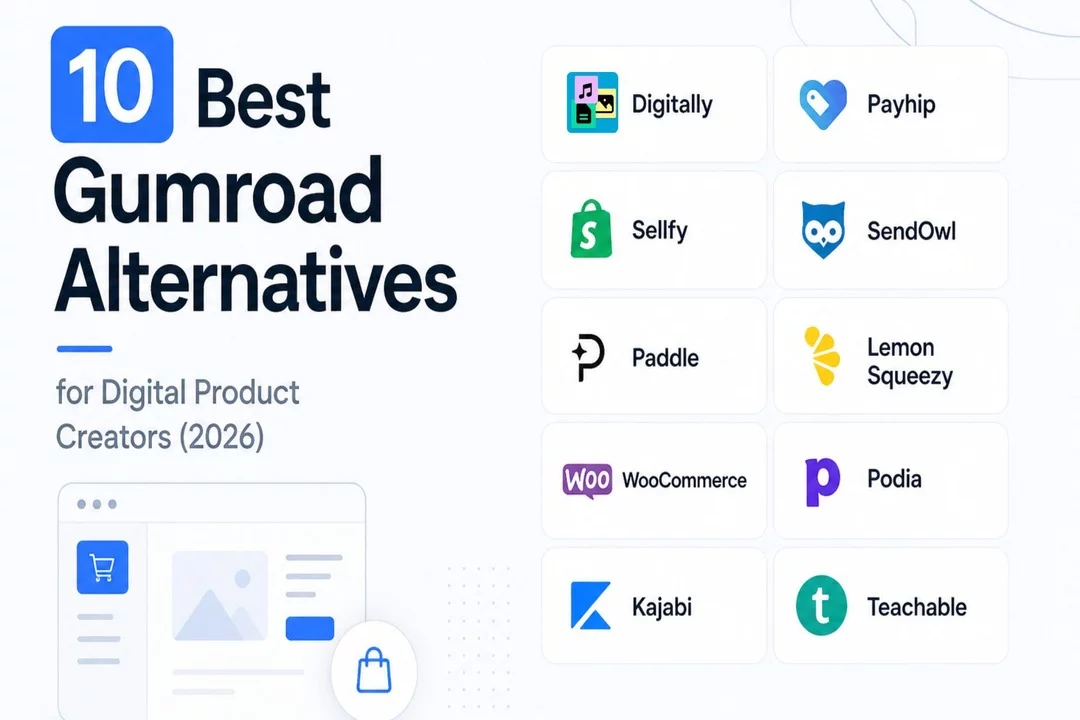
10 Best Gumroad Alternatives for Digital Product Creators (2026)
If you’re selling digital products in 2026, chances are you’ve either used or considered Gumroad.
It’s simple. It’s beginner-friendly. It’s fast to launch.
But for many creators, there comes a point where Gumroad starts to feel limiting.
Maybe the transaction fees are eating into your profits.
Maybe you want more control over branding.
Maybe you’re ready to scale beyond a basic storefront.
If you’re searching for gumroad alternatives for digital products or comparing the best gumroad alternatives, this in-depth guide walks you through the top 10 platforms — ranked, compared, and explained for real-world use cases.
Let’s break it down.
Why You Might Need a Gumroad Alternative
Gumroad is great for testing ideas. But it wasn’t built to power large, scalable digital brands.
Here are the most common reasons creators switch:
- Platform transaction fees
- Limited checkout customization
- Restricted store design
- Basic automation tools
- Limited integrations
- Marketplace-style dependency
If you’re serious about building a long-term digital business, you probably want:
- Full ownership of your brand
- Better margins
- Advanced marketing automation
- Flexible pricing models
- Subscription and bundle support
- Software license management
- Scalability
That’s where alternatives come in.
How We Ranked the Best Gumroad Alternatives
To create this list, we evaluated each platform using seven criteria:
1. Pricing & Fees
- Monthly cost
- Transaction percentage
- Payment processing charges
2. Features & Capabilities
- Secure digital delivery
- License key distribution
- Subscriptions
- Bundles
- Affiliate systems
- Tax handling (VAT/GST)
3. Ease of Use
- Setup speed
- Dashboard simplicity
- Learning curve
4. Customization
- Store design flexibility
- Checkout control
- Branding ownership
5. Integrations
- Email marketing
- CRM
- Automation tools
- Analytics
- Payment gateways
6. Customer Support
7. Scalability
Now let’s explore the 10 best Gumroad alternatives in 2026.
1. Shopify + Digitally (Best Overall Alternative)
Platform: Shopify
Digital Delivery App: Digitally
If you want the most powerful, scalable, and brand-controlled solution, Shopify + Digitally stands out as the strongest Gumroad alternative in 2026.
Unlike marketplace platforms, Shopify gives you a fully customizable online store. Digitally handles secure file delivery, license keys, and digital product automation.
Why It’s the Best Overall
Full Store Ownership
You control:
- Domain
- Branding
- Checkout experience
- Customer data
No marketplace restrictions.
Advanced Digital Delivery
With Digitally, you can:
- Instantly deliver files
- Limit downloads
- Use expiring links
- Update files automatically
- Distribute license keys
- Track downloads
- Restrict file sharing
Marketing & Sales Power
Shopify’s ecosystem gives you:
- Discount codes
- Bundles
- Subscriptions
- Upsells
- Cross-sells
- Abandoned cart recovery
- 8,000+ app integrations
Pricing Overview
- Shopify plans start around $39/month
- Digitally offers usage-based tiers (including free plans)
- No platform-level revenue cut like Gumroad
Pros
- Maximum scalability
- Lowest long-term fees
- Strongest customization
- Enterprise-ready
- Best for serious brands
Cons
- Slightly more setup required than Gumroad
Best For: Growing creators, software sellers, scaling brands.
2. Payhip
Payhip is one of the closest “plug-and-play” Gumroad-style platforms.
Pricing
- Free plan with 5% transaction fee
- Paid plan (~$29/month) with no fee
Strengths
- Simple setup
- EU VAT handling included
- Subscription support
- Built-in affiliate system
Limitations
- Limited store customization
- Basic checkout design
- Less scalable long term
Best For: Beginners testing product-market fit.
3. Sellfy
Sellfy blends digital sales with print-on-demand features.
Pros
- Built-in email marketing
- Clean UI
- Subscription support
- Physical + digital support
Cons
- Limited design control
- Smaller integration ecosystem
Best For: Creators selling both digital and merch.
4. SendOwl
SendOwl focuses heavily on digital delivery.
Pros
- Secure file delivery
- License key support
- Drip content
- Clean interface
Cons
- No full standalone storefront
- Limited marketing tools
Best For: Simple digital file delivery without complex storefront needs.
5. Paddle
Paddle is built primarily for SaaS and software businesses.
Pros
- Global tax compliance
- Subscription management
- Revenue share model
- Merchant of record
Cons
- Complex setup
- Not ideal for simple PDFs or downloads
Best For: SaaS founders selling subscriptions globally.
6. Lemon Squeezy
Lemon Squeezy is increasingly popular among indie software developers.
Pros
- License key management
- Tax compliance
- Subscription billing
- Clean interface
Cons
- Platform dependency
- Limited storefront customization
Best For: Indie developers selling software tools.
7. WooCommerce + Plugins
WooCommerce is an open-source WordPress plugin.
Pros
- Fully customizable
- No platform revenue share
- Huge plugin ecosystem
- Complete control
Cons
- Requires hosting
- Technical maintenance required
- Security management is your responsibility
Best For: WordPress users wanting full control.
8. Podia
Podia is designed for course creators and membership sites.
Pros
- Courses + downloads
- Built-in email marketing
- Community tools
- Simple interface
Cons
- Limited checkout customization
- Less advanced store design
Best For: Course creators and membership sellers.
9. Kajabi
Kajabi is a premium all-in-one course platform.
Pros
- Funnels included
- High-end course tools
- Community features
- Strong automation
Cons
- Expensive
- Overkill for simple downloads
Best For: High-ticket course businesses.
10. Teachable
Teachable is another strong option for structured learning programs.
Pros
- Easy course builder
- Good student management
- Subscription support
Cons
- Branding limitations on lower plans
- Transaction fees on entry tiers
Best For: Online educators.
Comprehensive Comparison Table
Platform | Starting Cost | Transaction Fee | Custom Store | License Keys | Best For |
Shopify + Digitally | $39+ | Low | Full | Yes | Scaling brands |
Payhip | Free | 5% | Limited | No | Beginners |
Sellfy | $29 | 0% | Moderate | No | Hybrid sellers |
SendOwl | $15 | 0% | No | Yes | Simple delivery |
Paddle | Revenue share | % | No | Yes | SaaS |
Lemon Squeezy | Revenue share | % | Limited | Yes | Indie software |
WooCommerce | Variable | 0% | Full | Plugin | WordPress users |
Podia | $39 | 0% | Limited | No | Courses |
Kajabi | $149 | 0% | Moderate | NO | Premium courses |
Teachable | $39 | % on lower plans | Limited | No | Educators |
Best Platforms by Use Case
Best for Beginners
Payhip
Best for Scaling
Shopify + Digitally
Best for Courses
Kajabi or Podia
Best for Software
Paddle or Lemon Squeezy
Best Overall Value
Shopify + Digitally
Final Recommendation
If you’re just testing a small product, simpler tools like Payhip or Sellfy might be enough.
But if you’re building a long-term brand — especially if you want:
- Full ownership
- Lower fees at scale
- License key automation
- Advanced marketing tools
- Complete customization
- Scalability beyond 6 figures
Then Shopify + Digitally is the most future-proof Gumroad alternative in 2026.
You control your brand.
You control your margins.
You control your growth.
Ready to Choose?
Want help deciding?
👉 Try Digitally on Shopify and build a digital business you truly own.
Frequently Asked Questions
The best gumroad alternatives for digital products in 2026 depend on your goals.
- Shopify + Digitally – Best for scaling and full brand ownership
- Payhip – Best for beginners
- Sellfy – Good for hybrid sellers
- Paddle – Best for SaaS
- Lemon Squeezy – Great for indie software developers
If you want long-term growth, automation, and lower fees at scale, Shopify combined with Digitally is usually the strongest choice.
For serious creators,
yes, While Gumroad is easier to start with, Shopify offers full customization, better branding control, advanced integrations, and lower long-term costs.
When paired with Digitally, Shopify becomes a powerful digital delivery system with secure file hosting, license key distribution, download limits, and automation — making it far more scalable than Gumroad.
If you want the simplest setup possible, Payhip is one of the most beginner-friendly platforms.
It offers:
- Easy store setup
- Built-in VAT handling
- Subscription support
- A free plan with transaction fees
However, beginners planning to grow quickly may benefit from starting directly with Shopify + Digitally to avoid migrating later.
For software sellers, platforms like Paddle and Lemon Squeezy are strong options because they support subscription billing and tax compliance.
However, Shopify combined with Digitally is also a powerful solution. Digitally allows you to import or auto-generate license keys, assign them per purchase, and track usage — making it ideal for SaaS founders who want full store ownership.
Yes, but migration difficulty depends on the platform you choose.
Moving to beginner platforms like Payhip or Sellfy is relatively simple. Migrating to Shopify may require more setup (design, payment configuration, product imports), but it offers much greater long-term flexibility and scalability.
The key steps usually include:
- Exporting customer data
- Migrating product files
- Rebuilding product pages
- Reconfiguring email automations
For creators focused on scaling, brand building, and profit margins, Shopify + Digitally typically offers the best long-term value.
Why?
- No platform revenue share
- Full brand ownership
- Advanced automation
- Massive integration ecosystem
- Custom checkout
- Scalability beyond six figures
While other platforms are easier initially, Shopify with Digitally provides stronger control, flexibility, and profitability over time.
digitally
gumroad alternatives for digital products
best gumroad alternatives
Shopify vs Gumroad
sell software downloads
best ecommerce platform for creators
digital business tools 2026

Digitally ‑ Digital Products
Sell files, e-books, license keys, promo codes & digital links
 Install Now