How to Track Ticket Deliveries and Customer Orders in Real Time
Managing ticket sales is more than simply accepting payments and sending tickets. As ticket volumes grow, businesses need a reliable way to manage customer orders, monitor ticket delivery, and quickly identify whether an order has been successfully delivered.
Without clear order visibility, it can become difficult to answer important questions:
- Has the customer's order been processed?
- Were the tickets delivered successfully?
- Which orders are still pending?
- Did a customer experience a delivery problem?
- How can support teams quickly find an order?
- Are all customers receiving their tickets on time?
Real-time order and delivery tracking can solve these challenges by giving businesses a clearer view of every customer transaction.
With Tickelo, Shopify merchants can manage ticket-related orders more efficiently while improving visibility throughout the customer journey.
Why Real-Time Ticket and Order Tracking Matters
When customers purchase event tickets online, they expect a smooth experience from checkout to delivery. Any uncertainty after payment can lead to unnecessary support requests and frustrated customers.
For example, a customer may contact your support team asking whether their tickets were delivered. If your team has no centralized order information, they may need to manually search through emails, Shopify orders, or other systems.
Real-time tracking makes this process much easier.
Instead of relying on manual checks, merchants can monitor order information and delivery status from a centralized workflow.
This provides several benefits:
- Better visibility into customer orders
- Faster customer support
- Easier identification of pending orders
- Fewer delivery-related questions
- More organized ticket management
- A better overall customer experience
What Is Real-Time Ticket Delivery Tracking?
Real-time ticket delivery tracking means having visibility into the status of a customer's order and ticket delivery as the order moves through the purchasing process.
typical workflow may look like this:
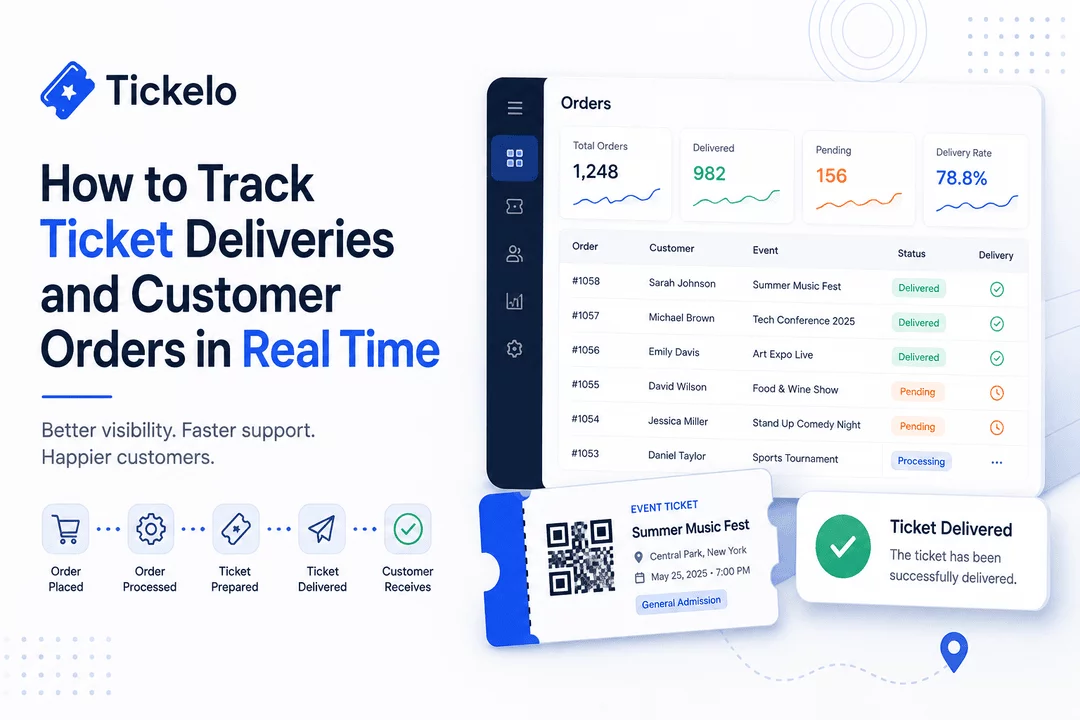
Customer places order → Order is processed → Ticket is prepared → Ticket is delivered → Customer receives ticket
Instead of treating this as a single transaction, merchants can use order information to understand what is happening at each stage.
This becomes especially valuable when managing a large number of customers or multiple events.
The Connection Between Customer Orders and Ticket Delivery
Customer order management and ticket delivery are closely connected.
An order contains important information about the customer and their purchase, while ticket delivery represents the fulfillment of that purchase.
When these two processes are properly connected, merchants can more easily understand:
Who purchased → What they purchased → When they purchased → Order status → Delivery status
This creates a more complete picture of the customer journey.
For example, if a customer says they haven't received their ticket, your team should be able to locate the order and determine what happened without searching through multiple systems.
1. Centralize Customer Order Information
The first step toward better delivery visibility is keeping customer order information organized.
Instead of manually tracking orders in spreadsheets or separate systems, merchants can use their Shopify order workflow as the central source of information.
Important order details may include:
- Customer name
- Customer email
- Order number
- Purchased tickets
- Event information
- Order date
- Order status
- Delivery information
Centralized information makes it easier for your team to find a specific customer order when assistance is required.
It also reduces the chance of losing track of an order as sales volume increases.
2. Monitor Ticket Delivery Status
Knowing that an order was placed isn't always enough.
Merchants also need visibility into what happens after the purchase.
A useful ticket management workflow should help businesses distinguish between orders that are:
- Successfully processed
- Ready for delivery
- Delivered
- Pending
- Requiring attention
Having these statuses available makes it easier to identify potential problems before they become major customer-service issues.
For example, if several orders remain pending while most other orders have already been delivered, your team can investigate those orders immediately.
3. Make Customer Support Faster
One of the biggest advantages of real-time order visibility is faster customer support.
Imagine a customer sends this message:
"I purchased my ticket but haven't received it yet. Can you check my order?"
Without proper tracking, a support agent may need to ask for additional information and manually search through different platforms.
With centralized order information, the agent can quickly locate the purchase and determine its current status.
This means support teams can spend less time investigating basic order questions and more time resolving actual problems.
4. Reduce Delivery Uncertainty
Customers want confidence after completing a purchase.
A lack of information can create uncertainty, especially when the customer has paid for an event ticket but doesn't immediately know what happens next.
Clear order and delivery tracking helps create a more transparent experience.
Instead of wondering whether their order has been processed, customers can receive the information they need through the appropriate order and delivery workflow.
This can help reduce repetitive questions such as:
- "Where is my ticket?"
- "Has my order been processed?"
- "When will I receive my ticket?"
- "Did my payment go through?"
- "Can you check my order?"
5. Identify Problems Earlier
Real-time visibility isn't only useful after something goes wrong.
It can also help merchants identify potential problems earlier.
Suppose your store receives hundreds of ticket orders for an upcoming event. If a group of orders remains in a pending state, that could indicate an issue with processing or delivery.
Without visibility, these problems may remain unnoticed until customers start contacting support.
With better order monitoring, merchants can identify unusual patterns and investigate them earlier.
This proactive approach can prevent small delivery problems from becoming widespread customer-service issues.
6. Manage High-Volume Ticket Sales More Efficiently
Manual order management becomes increasingly difficult as ticket sales grow.
A small event may generate a manageable number of orders, but large events, promotions, or popular ticket releases can generate hundreds or thousands of transactions.
At that scale, manually checking each order isn't practical.
An organized ticket management system allows merchants to work with order information more efficiently.
Instead of asking:
"What is happening with every order?"
your team can focus on:
"Which orders need attention?"
That difference can significantly improve operational efficiency.
7. Use Shopify as the Foundation for Order Management
For Shopify merchants, keeping ticket-related order information connected to the store's existing ecommerce workflow can simplify operations.
Shopify already provides merchants with important customer and order information. A ticketing solution can build on that foundation to make ticket sales and fulfillment easier to manage.
With Tickelo, merchants can incorporate ticket management into their Shopify-based selling workflow rather than creating an entirely separate ecommerce process.
This can make it easier to manage customer purchases while maintaining better visibility over ticket fulfillment.
8. Create a Better Customer Experience
Order tracking isn't only an internal business function.
It directly affects the customer experience.
A customer who receives clear information about their purchase is more likely to feel confident about the transaction.
A well-organized process can provide a smoother journey:
Browse event → Purchase ticket → Order confirmation → Ticket delivery → Event attendance
Every stage matters.
When delivery information is unclear, customers may become anxious or contact support unnecessarily. When the process is organized, customers can move from purchase to event attendance with greater confidence.
9. Keep Order Data Easy to Find
Speed matters when managing customer support.
If a customer contacts your team shortly before an event, your staff should be able to locate their order quickly.
Useful search and organization capabilities can help teams find orders based on information such as:
- Order number
- Customer name
- Customer email
- Event
- Purchase details
The easier it is to locate an order, the faster your team can provide an answer.
This is particularly important during busy periods when support requests increase.
10. Track the Customer Journey From Purchase to Delivery
The best approach to ticket management is to think beyond the individual transaction.
Every ticket order is part of a customer journey.
That journey begins when the customer discovers the event and continues through checkout, ticket delivery, and eventually event attendance.
Tracking the order throughout this process gives merchants better visibility and helps identify where improvements may be needed.
For example, if customers frequently contact support after purchasing, the issue may not necessarily be the ticket itself. The problem could be unclear delivery information or a lack of communication.
Order visibility can help merchants identify these friction points.
How Tickelo Can Help Improve Delivery Visibility
For Shopify merchants selling event tickets, Tickelo provides a ticketing-focused workflow designed to make managing ticket sales more convenient.
Instead of treating ticket sales and customer orders as disconnected processes, merchants can organize their ticket-selling workflow around their Shopify store.
This can help businesses:
- Manage customer ticket orders
- Keep purchase information organized
- Improve visibility into ticket fulfillment
- Respond to customer questions more quickly
- Reduce manual order checking
- Create a smoother ticket purchasing experience
The goal isn't simply to track orders. It's to give merchants a clearer understanding of what is happening with their customers' purchases.
Best Practices for Real-Time Ticket Order Management
To get the most value from real-time order tracking, merchants should establish a consistent process.
Keep order information organized
Make sure important customer and ticket information is easy to locate.
Monitor pending orders
Don't focus only on completed transactions. Pending orders may require attention before customers notice a problem.
Make support access simple
Customer support teams should be able to locate orders without unnecessary manual searching.
Review delivery issues regularly
Look for repeated delivery problems or customer questions that may indicate weaknesses in the current workflow.
Automate where possible
Automation can reduce repetitive tasks and help your team handle larger ticket volumes without increasing manual workload.
Communicate clearly with customers
Clear order confirmations and delivery information can significantly reduce customer uncertainty.
Final Thoughts
Real-time ticket and customer order tracking can make a significant difference for Shopify merchants selling event tickets.
When businesses have clear visibility into customer orders and ticket delivery, they can respond faster, identify problems earlier, reduce unnecessary support requests, and provide a better purchasing experience.
The key is to connect the entire process—from customer order to ticket delivery—into an organized workflow.
For Shopify merchants looking to simplify ticket management, Tickelo can help bring ticket sales and customer order management closer together, making it easier to maintain visibility as the business grows.
Better visibility doesn't just help merchants manage orders. It helps customers feel confident that their ticket purchase is being handled properly.
Frequently Asked Questions
Real-time ticket delivery tracking helps merchants know the status of customer orders, identify pending deliveries, respond to support requests faster, and reduce uncertainty throughout the ticket purchasing process.
Merchants can improve order visibility by centralizing customer information, monitoring order and delivery statuses, keeping ticket data organized, and using automated tools that connect ticket fulfillment with their ecommerce workflow.
Yes. Tickelo helps Shopify merchants organize ticket sales and customer orders within their Shopify-based workflow, making it easier to manage purchases and improve visibility into ticket fulfillment.
Order tracking allows support teams to quickly locate a customer's purchase and check relevant order or delivery information. This reduces investigation time and helps agents provide faster, more accurate responses.
Merchants should monitor order status, ticket fulfillment, pending orders, delivery issues, customer information, and unusual patterns that could indicate a problem with the ticket delivery process.
Tickelo can help merchants create a more organized ticket-selling workflow by connecting ticket sales with customer order management. Better visibility can reduce delivery uncertainty and provide customers with a smoother purchasing experience.
Ticket Delivery
Customer Order Management
Tickelo
Shopify Ticketing
Digital Ticket Delivery
Ticket Fulfillment

 Install Now