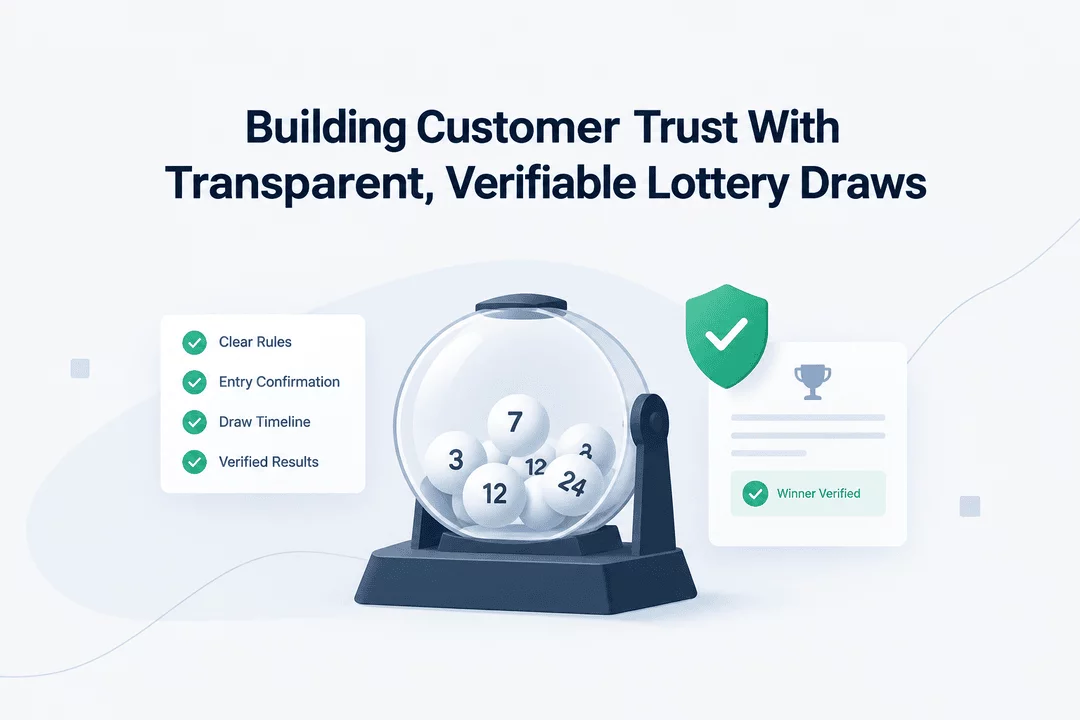
Building Customer Trust With Transparent, Verifiable Lottery Draws
Trust is one of the most important factors in the success of an online lottery or raffle. When customers purchase entries for a chance to win a prize, they want to know that the process is fair, the rules are clear, and the winner will be selected as promised.
For Shopify merchants, building this trust involves more than offering attractive prizes or creating an engaging lottery page. Customers also need confidence in how entries are recorded, when the draw takes place, and how the winning result is determined.
A transparent and verifiable lottery draw helps address these concerns by making the process easier to understand, follow, and review.
By communicating lottery rules clearly, confirming entries, documenting important draw milestones, and sharing winner announcements, merchants can create a more reliable customer experience.
In this guide, we'll explore how transparent, verifiable lottery draws help build customer trust, which practices merchants can implement, and how Shopify apps like Tickelo can support a more organized raffle experience.
1. Why Customer Trust Matters in Online Lotteries
Online lotteries and raffles rely on customer confidence. Unlike traditional retail purchases, where customers receive a product directly, lottery participants pay for an opportunity to win a prize.
This makes transparency especially important.
Customers may have questions such as:
- Has my entry been successfully recorded?
- Are the lottery rules clear and accessible?
- When will the draw take place?
- How will the winner be selected?
- Where can I find the results?
- Will the announced winner actually receive the prize?
If merchants leave these questions unanswered, customers may feel uncertain about participating.
On the other hand, a clearly explained lottery process helps set expectations before purchase and gives customers useful information throughout the experience.
Trust is built when customers can understand what is happening, verify the information available to them, and see that the merchant follows the published rules.
For Shopify merchants, this can contribute to stronger customer relationships, greater confidence in future promotions, and a more professional brand experience.
2. What Makes a Lottery Draw Transparent and Verifiable?
Transparency and verifiability are closely related, but they serve different purposes.
Transparency means making important lottery information visible and understandable to participants. Verifiability means providing sufficient evidence or records to allow relevant parts of the process to be checked.
A lottery may be transparent about its draw date, for example, but still provide little information about how the winner was selected.
A well-structured lottery experience considers both.
Clear and accessible rules
Participants can review the prize details, entry requirements, eligibility conditions, closing date, and draw process before entering.
Reliable entry records
Customers receive confirmation that their entries have been recorded, while merchants maintain accurate records of eligible entries.
Visible draw timeline
The opening date, entry deadline, and scheduled draw date are communicated clearly, with updates when necessary.
Documented winner selection
The merchant explains how the winning entry is selected and retains appropriate records to support the result.
Clear result communication
Participants can find the draw outcome, the winner announcement, and relevant follow-up information.
Together, these practices help make the lottery experience easier for customers to understand and easier for merchants to manage.
3. Publish Clear Lottery Rules Before Customers Enter
One of the simplest ways to build customer trust is to make lottery rules available before a customer purchases an entry.
Unclear terms can create confusion, especially when customers are unsure about eligibility, entry limits, prize details, or draw timing.
Merchants should clearly communicate:
- The prize being offered and its relevant details
- Entry price and available entry methods
- Eligibility requirements and geographic restrictions
- The lottery opening and closing dates
- The scheduled draw date and time, including the time zone
- How the winner will be selected
- How and when the winner will be contacted
- Any applicable claim deadlines or prize delivery conditions
Rules should be written in straightforward language and displayed where customers can easily find them.
If any details change, merchants should communicate those changes clearly and in accordance with the published terms and applicable requirements.
For Shopify stores, a dedicated lottery or raffle product page can serve as a central location for this information.
When customers understand the conditions before participating, they can make informed decisions and are less likely to encounter unexpected surprises later.
4. Confirm Entries and Maintain Accurate Records
Entry confirmation is another important part of a trustworthy lottery experience.
After purchasing an entry, customers want reassurance that their participation has been recorded successfully. Without confirmation, they may wonder whether their order went through or whether they are included in the upcoming draw.
Merchants can improve this experience by providing:
- An order confirmation that acknowledges the lottery purchase
- Clear information about the number of entries purchased
- Entry identifiers or ticket numbers, where applicable
- Instructions for contacting support if an entry appears to be missing
Behind the scenes, merchants should maintain accurate entry records and ensure that the eligible entries used for the draw are consistent with the published lottery rules.
For example, if a customer purchases multiple entries, the merchant should have a reliable way to account for those entries according to the lottery's stated structure.
Accurate records help merchants investigate customer questions, resolve discrepancies, and explain how the final draw was conducted.
The goal is simple: customers should not have to guess whether their participation has been recorded.
5. Make the Lottery Timeline Easy to Follow
Uncertainty about timing can weaken customer confidence.
If customers don't know when entries close or when the winner will be announced, they may become frustrated or question whether the lottery is proceeding as expected.
A visible lottery timeline helps eliminate this uncertainty.
Example: A transparent lottery timeline
- Entries Open
- The lottery launches, and customers can review the rules and purchase eligible entries.
- Entries Close
- The published entry period ends, and the merchant finalizes the eligible entries according to the lottery rules.
- Draw Takes Place
- The winner is selected using the disclosed selection method and applicable eligibility criteria.
- Winner Selected
- The result is recorded, and any required eligibility or winner verification is completed.
- Winner Announced
- The merchant communicates the result and explains any next steps for claiming the prize.
A clearly communicated timeline gives participants a shared understanding of what happens next.
If a draw must be postponed or a schedule changes, merchants should explain the update, provide the revised timeline, and communicate it through appropriate channels.
Keeping participants informed demonstrates that the merchant takes their participation seriously.
6. Explain How Winners Are Selected
Winner selection is often the most sensitive part of an online lottery.
Even when a merchant conducts a draw fairly, customers may question the result if the selection process is not explained.
To improve transparency, merchants should describe the method used to select the winner before the lottery begins.
Depending on the lottery format, this may involve a random selection from eligible entries or another clearly defined method.
The merchant should communicate relevant details, such as:
- Which entries are eligible for the draw
- How the winning entry is selected
- How duplicate, invalid, or ineligible entries are handled
- Whether any verification occurs before a winner is confirmed
- What happens if the selected entrant cannot claim the prize
Merchants should also retain appropriate draw records, such as the draw date, eligible entry information, selection outcome, and relevant audit logs, where available.
These records can help answer questions about the result and support internal review if a dispute arises.
Importantly, a claim that a draw is random is not the same as independently verifiable proof of randomness.
If a merchant wants to describe a draw as independently verified, certified, or auditable, that claim should be supported by the actual process and evidence available. Avoid promising guarantees that the system cannot substantiate.
7. Share Winner Announcements and Draw Results
The customer experience shouldn't end when the draw is complete.
A clear winner announcement helps close the loop for participants and demonstrates that the lottery reached its stated conclusion.
A useful winner announcement may include:
- The lottery or raffle name
- The date the draw took place
- The winning ticket number or another permitted identifier
- The winner's name, only where appropriate and with suitable consent
- The prize won
- Information about prize confirmation or delivery, where relevant
Merchants should respect customer privacy and avoid publishing unnecessary personal information. A partial name or ticket identifier may be more appropriate than disclosing a winner's full identity.
For recurring lotteries, maintaining an accessible history of completed draws can also help customers review previous outcomes.
This is particularly useful for returning customers who want to understand how the merchant has handled earlier promotions.
A timely, clear, and appropriately documented winner announcement helps demonstrate accountability and gives participants a meaningful conclusion to the experience.
8. Use Technology to Support a More Transparent Lottery Experience
Managing an online lottery manually can become complicated as entry volumes increase.
Merchants may need to coordinate entry records, customer communication, lottery deadlines, winner selection, and result announcements. Disconnected tools and manual processes can introduce errors or make it harder to respond to customer questions.
Shopify lottery and raffle apps can help merchants organize these activities within their store's workflow.
However, technology alone does not guarantee a fair or verifiable draw. Merchants should understand what an app actually records, automates, and makes available for review.
When evaluating a lottery solution, consider whether it supports:
- Organized entry and order management
- Clear lottery setup and published rules
- Reliable tracking of lottery participation
- A defined winner-selection workflow
- Draw result records or history
- Customer-facing communication about lottery outcomes
Choosing tools that match the merchant's actual requirements can reduce operational complexity and make it easier to maintain a consistent process.
9. How Tickelo Helps Shopify Merchants Create an Organized Raffle Experience
For Shopify merchants, creating a trustworthy raffle experience means managing more than just the prize. The entire process—from setting up the raffle to communicating the outcome—needs to be clear and organized.
Tickelo is designed to help Shopify merchants run raffle experiences within their stores, making it easier to organize raffle promotions and manage the customer journey.
By using Tickelo as part of their Shopify raffle workflow, merchants can focus on presenting clear raffle information, organizing participation, and providing a more structured experience for customers.
When using Tickelo or any raffle management solution, merchants should align their published rules and customer-facing claims with the features they have configured and the records their setup actually provides.
For merchants looking to improve their raffle operations, a well-organized Shopify workflow can be a useful foundation for delivering a more consistent customer experience.
10. Best Practices for Building Long-Term Trust Through Lottery Transparency
Trust isn't established through a single draw. It's built over time through consistent communication, clear expectations, and responsible management.
Here are several practices Shopify merchants can adopt to support customer confidence across multiple lottery campaigns.
Lottery transparency checklist
- Publish clear rules before entries open
- Display accurate opening, closing, and draw dates
- Confirm customer entries and maintain reliable records
- Explain the winner-selection method
- Keep appropriate records of completed draws
- Communicate delays or changes promptly
- Announce results clearly and on time
- Protect winner and participant privacy
- Review customer feedback after each draw
Merchants should also review the legal requirements that apply to their specific promotion, including any rules concerning paid entries, participant eligibility, prize disclosures, and winner announcements. Requirements can vary by jurisdiction and lottery format.
A consistent, documented approach makes it easier to maintain transparency as the business grows and runs more promotions.
Conclusion
Building customer trust with transparent, verifiable lottery draws starts with a simple principle: participants should understand how the lottery works and what happens to their entries.
Clear rules, reliable entry records, visible timelines, documented winner selection, and timely result announcements all contribute to a more accountable lottery experience.
For Shopify merchants, these practices are not just operational details. They help establish expectations, reduce uncertainty, and create a more professional relationship with customers.
With an organized raffle workflow and tools such as Tickelo, merchants can work toward making their Shopify raffle experiences easier to manage and clearer for participants.
Ultimately, customer trust grows when merchants consistently communicate honestly, follow their published rules, and provide meaningful information about the outcome of every draw.
Frequently Asked Questions
A transparent lottery draw is one in which participants can access clear rules, understand how entries are handled, know when the draw will take place, and learn how the winner is selected and announced.
Verification depends on the draw method and the evidence available. Relevant records may include eligible entry lists, draw timestamps, selection logs, and documented results. Independent verification requires an appropriate verification process beyond simply announcing a winner.
Explaining how winners are selected helps participants understand the process and reduces uncertainty about the outcome. It also gives merchants a clearer basis for responding to questions or disputes.
Shopify merchants can improve trust by publishing clear raffle rules, confirming entries, displaying important dates, explaining winner selection, keeping appropriate records, and announcing results promptly.
Tickelo helps Shopify merchants organize raffle experiences within their stores. Merchants can use a structured raffle workflow to support participation management and create a more consistent customer experience.
Transparency alone does not guarantee fairness. A trustworthy process also depends on following published rules, maintaining accurate records, using the disclosed selection method, and meeting applicable legal requirements. Independent verification may provide additional assurance when properly implemented.
transparent lottery draws
Tickelo
Shopify Raffles
Lottery Draws
Customer Trust
Draw Transparency
Shopify Apps

 Install Now
.png)